
History of Work
Click here to get started or read the introduction below!
#Introduction Central to history is the world of work in the past, as known by occupational activities. Yet comparative research in this field is severely hampered by confusion regarding occupational terminology across time and space, within as well as between languages. To overcome this, we create an occupational information system that is both internationaland historical, and simultaneously links to existing classifications used for present-day conditions. The information system uses a historical international classification of occupations (HISCO) to combine various kinds of information on their tasks and duties in historical settings, as well as images on the history of work. Moreover it provides information on rankings of occupations (HISCAM) and we aim for other resources in the future. Not just occupational scales and measures, but also depictions and occupational descriptions available through images and texts.
For questions please contact data AT iisg.nl.
Members


Introduction
This is your workbench for historical occupations as all graphs from the historyOfWork are combined here. This version is dated Feb 2021. Use this dataset to retrieve HISCO and HISCAM scores for an incredible amount of occupations in numerous languages.
Data can be queried (obtained) via the SPARQL endpoint or via the example queries. If the Linked Open Data format is new to you, you might enjoy these data stories on History of Work as Linked Open Data and this user question on Is there a list of female occupations?.
Figure 1. Part of model illustrating the basic relation between occupations, schema.org and HISCO.
Figure 2. Part of model illustrating the relation between occupation, provenance and HISCO auxiliary variables.
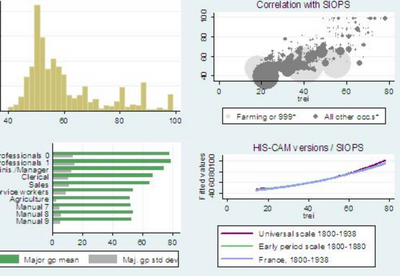
HISCAM-latest
Current version HISCAM 1.3.1 Feb 2021. HISCAM scales as per Lambert et al 2013. Indicate 'high' and 'low' positions of occupations for various time periods and countries. Here provided as Linked Open Data. Please cite us when using this data.
History of Work
Here you find the History of Work resources as Linked Open Data. It enables you to look ups for HISCO and HISCAM scores for an incredible amount of occupational titles in numerous languages.
Data can be queried (obtained) via the SPARQL endpoint or via the example queries. If the Linked Open Data format is new to you, you might enjoy these data stories on History of Work as Linked Open Data and this user question on Is there a list of female occupations?.
NEW version - CHANGE notes
This version is dated Apr 2025 and is not backwards compatible with the previous version (Feb 2021). The major changes are:
- incredible simplification of graph representation (from 81 to 12);
- use of sdo (https://schema.org/) rather than schema (http://schema.org);
- replacement of prov:wasDerivedFrom with sdo:isPartOf to link occupational titles to originating datasets;
- etl files (used for conversion to Linked Data) now publicly available via https://github.com/rlzijdeman/rdf-hisco;
- update of issues with language tags;
- specfication of language tags for english (eg. @en-gb, instead of @en);
- new preferred API: https://api.druid.datalegend.net/datasets/HistoryOfWork/historyOfWork-all-latest/sparql (old API will be deprecated at some point: https://api.druid.datalegend.net/datasets/HistoryOfWork/historyOfWork-all-latest/services/historyOfWork-all-latest/sparql ) .
There are bound to be some issues. Please leave report them here.
Figure 1. Part of model illustrating the basic relation between occupations, schema.org and HISCO.
Figure 2. Part of model illustrating the relation between occupation, provenance and HISCO auxiliary variables.
jobHoard-latest
This is the latest dataset (feb 2021) that contains coded occupations (e.g. HISCO) that have been donated by the community.
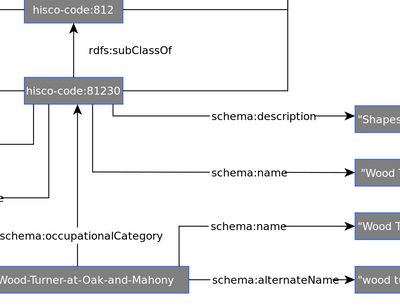
HISCO-latest
Latest release (feb 2021) of the graph of the HISCO structure. NB: this graph just contains the HISCO structure, not any coded occupations.